Most beginner advice is still stuck in 2023. Here’s what actually works now.
Last updated: July 12, 2026
Digital marketing has shifted more in the last three years than in the decade before it, and a lot of the advice aimed at beginners hasn’t caught up. This guide breaks down what’s still true, what’s changed, and gives you a practical 90-day plan for getting started in 2026 — without wasting time or budget on tactics that no longer move the needle.
The Model That Still Works: Attention, Conversion, Retention
Despite everything that’s changed, one simple framework still holds up: think of your marketing as a triangle with three corners.
- Attention — how people discover you
- Conversion — what happens once they do
- Retention — how you keep them coming back
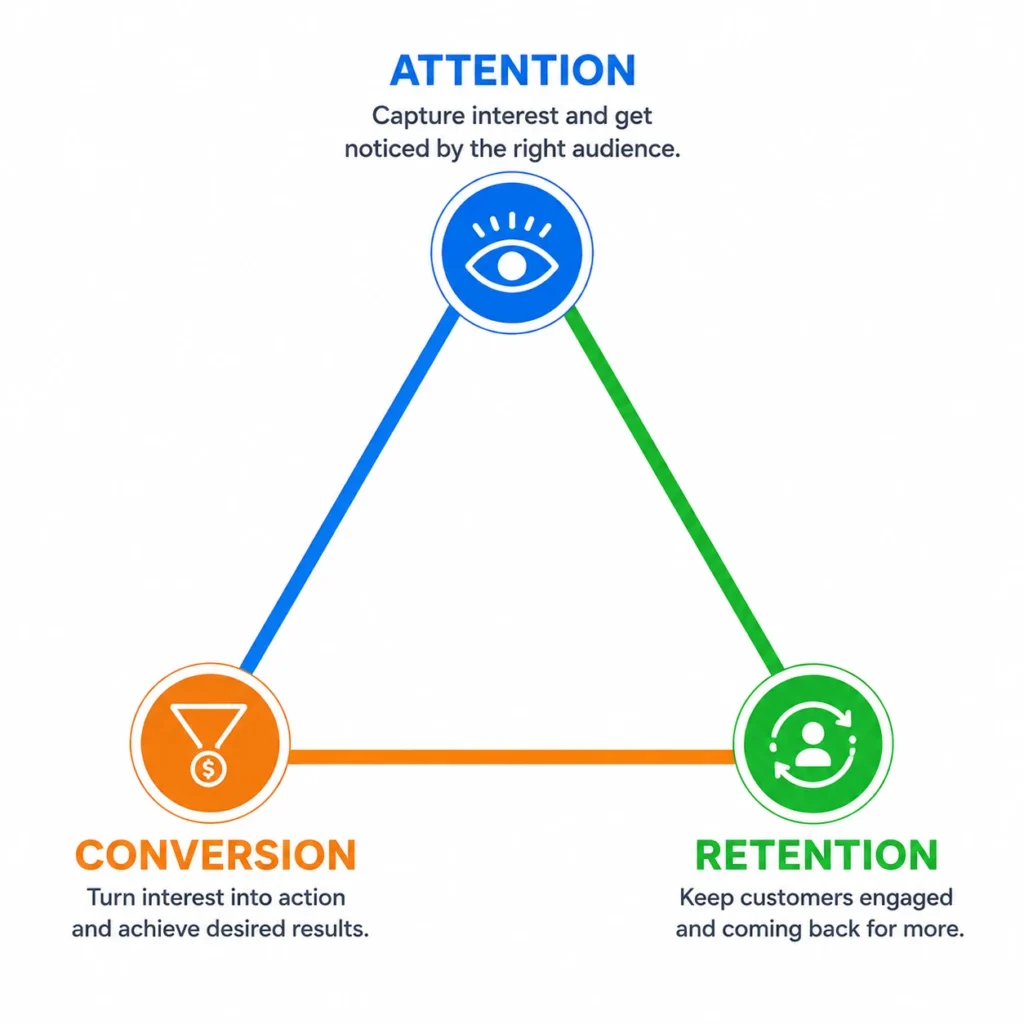
Most beginners default to chasing the attention corner — posting more, trying to go viral, obsessing over traffic. That instinct made more sense a few years ago. Today, organic reach is shrinking, ad costs keep climbing, and simply making more noise online rarely pays off. If you’re just starting out, conversion and retention are where your time is far better spent, because that’s what actually protects your revenue when attention gets harder and more expensive to earn.
Before You Pick a Strategy, Answer This
Before choosing any tactic, it’s worth stepping back and asking a more basic question: what are you actually selling? A product, a service, or yourself as a personal brand?
The answer changes almost everything downstream — your content format, your platform, even your definition of a “conversion.” Trying to be everywhere at once, covering every corner of your niche, is one of the fastest routes to burnout, and it usually means getting drowned out in a feed that’s already fighting for everyone’s attention. As you plan your approach, keep coming back to one question: does this actually make sense for my business?
The move that tends to work best for beginners is picking a single path and sticking with it for 90 days before judging the results. That’s long enough to gather real data, and short enough that you’re not locked in forever.
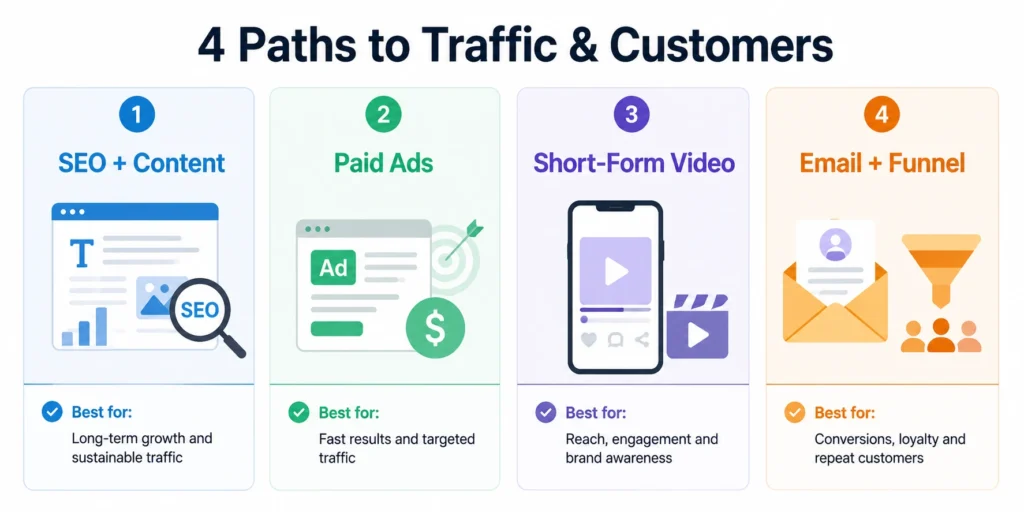
Four Paths to Choose From
Here are four common starting points. Pick the one that matches how your audience actually finds and evaluates businesses like yours.
Path 1: SEO + Content
Best for local businesses, blogs, or anything text-based — essentially, any business where a website can directly answer a customer’s question. A restaurant, for example, can realistically rank for something like “best contemporary cuisine near me.” If the answer to someone’s question — including a question they’d type into an AI chatbot — could reasonably be your business, this is a strong starting point.
Path 2: Paid Ads
Best if you already have some online presence and a specific product to push, or you want to accelerate something that’s already working. Paid ads amplify existing traction — they don’t create it. If you’re starting completely from zero, this is usually not the most efficient place to spend your first dollars; there are cheaper ways to learn about a brand-new audience first.
Path 3: Short-Form Video
Best for personal brands, creators, and visually driven businesses — anything where the product or process is inherently visual. If you’re in a visual medium, showing your audience the process, not just the finished product, tends to matter more for conversions than polish does.
If your product itself is something people can browse and buy on the platform, it’s worth pairing this path with a proper storefront setup — our guide to selling on Instagram with a small following covers exactly how to do that, even if your account is brand new.
Path 4: Email + Landing Page Funnel
Best for service-based businesses and online courses — anything where conversion depends on trust and recognition rather than an impulse purchase. You drive traffic to a single, well-structured page, capture an email address, and build the relationship from there. It’s lower in volume than the other paths, but it converts better and gives you far more usable data along the way.
The 90-Day Blueprint
The structure below is mapped out using an email-and-landing-page funnel as the example, but the same weekly rhythm applies to any of the four paths — only the specific tasks change.
Weeks 1–2: Build the Foundation
- Get a simple, one-page website live. It doesn’t need to be polished — it just needs to exist.
- Write a three-email welcome sequence built around one clear, compelling offer.
- Distribute that one-pager everywhere you reasonably can, to start generating initial attention.
How this looks by path:
| Path | Weeks 1–2 focus |
|---|---|
| SEO + Content | Draft three blog posts answering common questions about your business |
| Paid Ads | Launch a single ad pointing to one specific offer |
| Short-Form Video | Publish your first video with a link in your bio |
| Email + Funnel | One-pager live, welcome sequence written, and distributed |
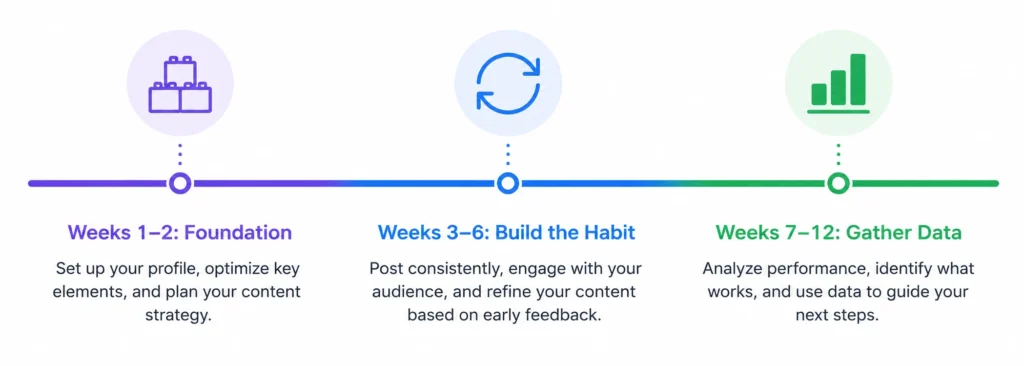
Weeks 3–6: Build the Habit
This stretch is about consistency, not perfection:
- Send one email per week to your subscriber list, even if that list is tiny to start.
- Start showing up in relevant communities — Reddit threads, niche forums, or social profiles — and drop your link naturally in your bio.
- Keep pushing attention toward your landing page rather than spreading it across too many places at once.
Weeks 7–12: Gather and Act on Data
This is where beginners often skip the most useful step: actually looking at the numbers that matter.
- Ignore subscriber count and raw traffic for now — they’re vanity metrics at this stage.
- Track open rate, click-through rate, and — most importantly — which specific emails or posts led someone to actually take action (book a call, make a purchase, sign up).
- Double down on whatever produced real results, and drop the rest.
By the end of the 90 days, you’ll have actual evidence of what moves your specific audience past the attention stage — not a guess, but data. From there, the cycle repeats: use what you learned to refine your landing page and welcome sequence, get back into the weekly rhythm, and revisit the data again at the next 90-day mark.
What’s Actually Changed Since 2023
The framework above is intentionally simple — almost too simple. That’s on purpose. But a few real shifts in the landscape are worth understanding, because they change how each path plays out in practice.
AI Search Is Reshaping Traffic
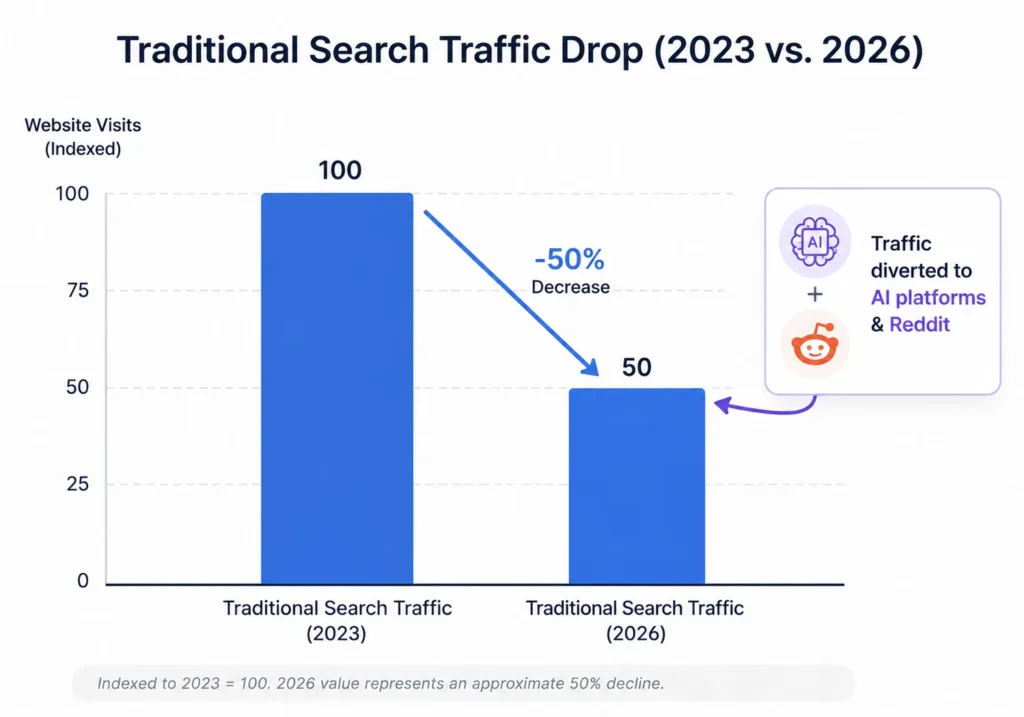
Across most industries, websites are seeing roughly half the organic traffic they used to, as more people get answers directly from AI tools or from community platforms like Reddit instead of clicking through search results. Two practical takeaways follow from this:
- Participating genuinely in relevant subreddits is a legitimate way to get your name into the conversation early.
- Don’t expect clean, measurable results from AI-driven visibility — it’s currently very difficult to track. What is clear is that AI tools tend to favor businesses that already have an established web presence, which makes now a better time to start than later, especially for local businesses.
Community Has Become a Growth Channel
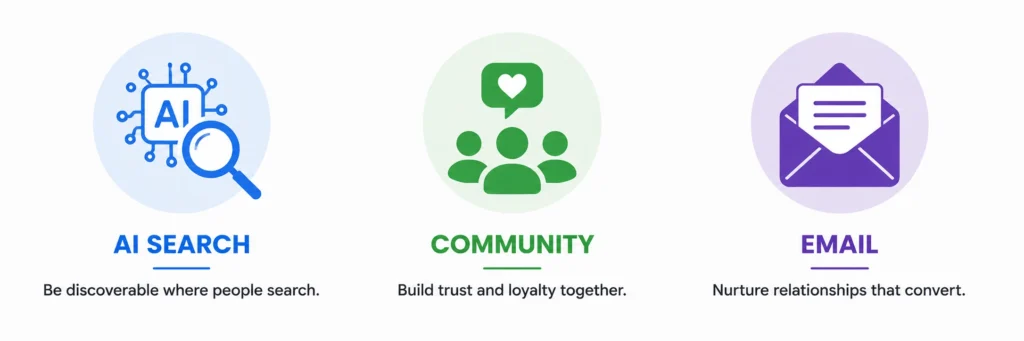
As AI-generated content floods the internet, people are gravitating toward spaces that feel genuinely human — and Google’s growing reliance on E-E-A-T (Experience, Expertise, Authority, Trustworthiness) rewards exactly that kind of content. Building or actively participating in an online community, whether that’s a subreddit, a Discord, or a newsletter with a comment section, does double duty: it builds trust with real people, and it functions as free, ongoing market research. Platforms like Substack are a good example of this model — a blog-style publishing tool paired with a built-in micro-community around the creator.
Email Marketing Is More Valuable, Not Less
One thing that hasn’t lost relevance is email. It remains one of the highest-return channels in digital marketing, and it’s become more important, not less, in a search landscape increasingly dominated by zero-click answers. Unlike social reach, which platforms control, email goes directly to someone who explicitly asked to hear from you — and the list itself is first-party data that you own outright, regardless of what any platform’s algorithm decides to do next.
The most useful mental shift here: stop treating email as an attention tool and start treating it as your primary conversion and retention layer. It’s how you stay in front of people even during the stretches when they don’t need you yet.
Quick Recap
| Phase | Focus |
|---|---|
| Before you start | Decide what you’re actually selling — product, service, or personal brand |
| Choose one path | SEO + Content, Paid Ads, Short-Form Video, or Email + Funnel |
| Weeks 1–2 | Build the minimum foundation and get it live |
| Weeks 3–6 | Build a consistent weekly habit |
| Weeks 7–12 | Gather data and double down on what converts |
| Ongoing | Repeat the 90-day cycle, refining with each round |
Frequently Asked Questions
SEO + Content or Email + Funnel tend to work better from a cold start than Paid Ads, since ads amplify existing traction rather than build it from scratch.
No — spreading effort across too many channels early on is one of the most common reasons beginners burn out without results.
Because they don’t reliably correlate with revenue. Metrics tied to actual conversions — click-throughs, bookings, purchases — are far more useful for deciding what to keep doing.
Yes. It remains one of the highest-ROI channels available, and it’s a stronger asset now that platform-driven reach and organic search traffic have both become less predictable.
This guide is based on practical, hands-on experience. Digital marketing trends shift quickly, so it’s worth revisiting your data and strategy every 90 days rather than treating any single framework as permanent.